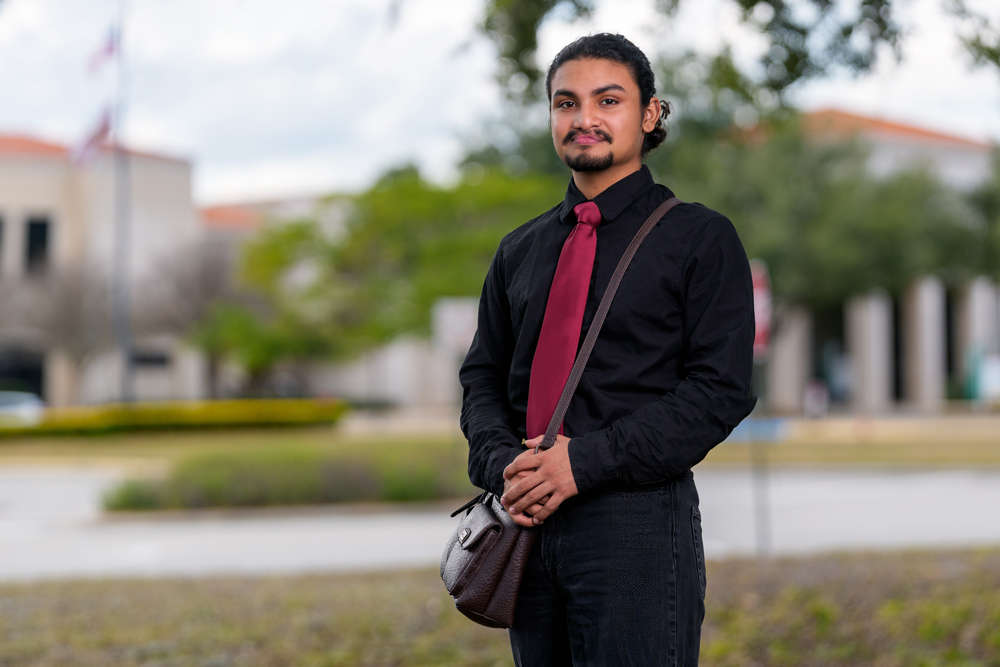
In high school, Carlos Cordero heard all about FAFSA, the Free Application for Federal Student Aid. That’s because guidance counselors and school officials talked about it a lot.
But Cordero figured that the FAFSA didn’t apply to him – and besides, he’d heard it was a hassle to fill out.
“In my head, I debated filling it out because I had heard that FAFSA isn’t guaranteed: A lot of people don’t get anything,” recalls Cordero. “I thought, ‘Do I really want to take time to fill out this form and I may not get anything?’
As a 2024 graduate of Gateway High School in Osceola County, Cordero was eligible for an Osceola Prosper scholarship. That eased his mind a lot, because he’d always assumed he’d have to use student loans to pay for college.
But the Prosper scholarship had one requirement: You have to fill out the FAFSA. (The Prosper scholarship is what is called a “last-mile scholarship,” meaning that the Prosper scholarship will pay whatever remaining tuition isn’t covered by Pell grants and other federal aid.)
So Cordero and his family filled it out — and to his surprise, he had a low Student Aid Index number – which meant that was eligible for a full Pell grant. In 2024-2025, students eligible for a full Pell grant received $7,395.
That, says Cordero, was an unexpected blessing.
“Not only is my full degree covered, I get a little extra when the funds come in each semester, ” he said.
Time to be a leader
Without worrying about finances, Cordero – who wants to become a middle- or high-school algebra teacher — can focus more on classes and his part-time job as a student leader at Valencia’s Osceola Campus.
“I love working here. It’s such a great job, not only planning the events and the relationships you form with people here, not just student leaders but other people on campus,” he said.
And, for someone who wants to become a teacher, working as a student leader provides a lot of insights into the teaching field.
“In my intro to education class, that’s one of the questions that we’ve thought about, because a big thing in in education, is you want to impact the lives of the students that you’re teaching, both in and out of the classroom,” Cordero said. “As a student leader, you get to do some of that. With the events we plan, we’re giving students the opportunity to do stuff that they may not be able to do on their own time, because of funds or because they don’t have the time.
“For instance, we sometimes have rock-climbing walls on campus. That’s something many students would never do. But you see not only students that come back, you see that students do appreciate the things you do for them.
“When we’re planning the events, you get to think a lot about students’ wants and needs and how you can incorporate that into an event,” he said. “It’s definitely one of the biggest things we try to do at Student Development — open doors for students who don’t have time on their own time.”